Thursday, September 13, 2018

Georgia Belle’s Calling Card Etiquette

One of my favorite items to show and discuss at our talks and teas, is a box of Georgia Belle Graber’s calling cards. Calling cards were the forerunners of today’s business cards. As she became “Mrs. Clifford Clement Graber” in 1907, and I was marrying his grandson and namesake in 1990, the box of cards, along with the copperplate for engraving, was an engagement gift to me from my late-mother in law, Betty Graber. Stop in and ask about them!
Pictured above and below– Georgia Belle Graber’s Edwardian era calling cards from 1907, sitting in an antique Pairpoint silver, calling card tray, atop two business cards for “Georgia Belle et Cie.” The tray features a tenacious dog who does not wish to give up the newspaper he has snagged and holds in his teeth. The newspaper is dated May 4, 1891 – 
On a reception day or at a tea you should leave your cards in the card tray in the hall on your departure. No call is necessary in acknowledgment of an afternoon tea. A card left or sent to a tea discharges the obligation.“ ~ from the Los Angeles Herald, 1891

“The wise woman carries cards with her wherever she goes, for there are many uses for them. Nowadays, she carries shopping cards also, and saves time and trouble when she makes purchases. A neatly engraved card is always in good taste, even when not strictly up to style, but a careful woman is modish in that, as in every other detail of her toilette.” 

Agony Aunt, Betty Bradeen’s, 1909 Etiquette Advice for Calling Card Use in the syndicated column, “Betty Bradeen’s Daily Chat”

“Sometimes I open letters to find that the desired information would be too late. That happens when social functions are looming up in the near future, and somebody has met a puzzling situation. Generally, such letters ask for information on the subject of visiting cards or notes of acceptance or regret. There are only a few rules governing the etiquette on such occasions, but they are important. Every woman should know them, even though she has no occasion for such knowledge. We learn a good deal which is never put to account, you know. 

“When a woman calls upon a new neighbor, she carries a card for each woman in the family and her husband’s cards as well, with one for the masculine head of the house. That is only for the first call; which is returned in like manner, and then the acquaintance is purely a matter of individual choice. The demands of etiquette have been met. Cards are convenient things even after terms of intimacy have been established, for they serve as reminders of visits whigh might be forgotten or might never be known. The wise woman carries cards with her wherever she goes, for there are many uses for them. Nowadays, she carries shopping cards also, and saves time and trouble when she makes purchases. A neatly engraved card is always in good taste, even when not strictly up to style, but a careful woman is modish in that, as in every other detail of her toilette.

“Letters of acceptance or regret are imperative, and shortcomings in this line are never overlooked. The sender of an invitation has a right to expect the courtesy of a reply of some sort — and the nature of the reply has much bearing upon the success of the function. In wedding invitations, the answers are sent to those who issue them, no matter whether there is an acquaintanceship or not. For instance, the parents of a bride send many such to friends of the bridegroom, persons they have never seen, but answers are due them just
the same.” –Betty Bradeen, 1909


Etiquette Enthusiast, Maura J. Graber, is the Site Editor for the Etiquipedia© Etiquette Encyclopedia

Sunday, August 19, 2018

Vintage Glove Etiquette

Glove fashion article from 1933 – We love history, etiquette and fashion! We also love talking about what we collect. Next time you are in the neighborhood, stop by the Graber Olive House for one of our Talks and Tea, or call 909-923-5650 in advance, to see what topics are on our upcoming schedule and see our collections of vintage fashion accessories and antique flatware in our La Casita shop. 


Glove Etiquette 

Don’t eat, drink, or smoke with gloves on.
Don’t play cards with gloves on.
Don’t apply makeup with gloves on.
Don’t wear jewelry over gloves, with the exception of bracelets.
Don’t make a habit of carrying your gloves.


For more glove etiquette, read one of Maura Graber’s post here on her Etiquette Sleuth Blog 

Sunday, July 29, 2018

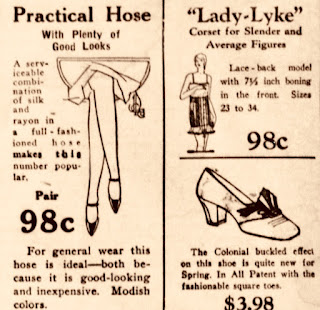
1920’s Women’s Fashions

What were women wearing in the late-1920’s?
“Fashion Experts Study Effects 
of World War I”
Fashion experts have been making a study of the world war and what it did to their business. They find, according to reports, that the war brought more sweeping changes in women’s fashions than ever occurred before in any given century.
      Here are some of the results chargeable to it: 
  • It cut a foot or so off the dress of all the women in Christendom. 
  • It wrecked the ancient petticoat business. 
  • It plunged the world's textile in dustries into despair. 
  • It abolished big hats, hair nets, whalebones, steel corsets, garters, veils and hatpins. 
According to one fashion expert, “Thus came about the greatest single revolution in dress since fig leaf aprons were abolished.’’
                                                        March 19, 1929

Etiquette Enthusiast, Maura J. Graber, is the the Site Curator for the Georgia-Belle.Blogspot

Saturday, June 16, 2018

Tea Table Etiquette


                 Patented design for a tea service
 in 1873
     
          Quaint Customs Once Observed by British Dames
Tea drinking has become very fashionable among us of late years, almost as much as it was in England a century ago, but the prevailing customs at the table are different. The "teacup times of hood and hoop" had their own etiquette, of a sort not likely to be revived. What should we think now of a fashionable lady who cooled her tea with her breath? 
Yet Young says of a certain bewildering Lady Betty:
Her two red lips affected zephyrs blow To cool the Bohea and inflame the beau. While one white finger and a thumb conspire To lift the cup and make the world admire.

Again a passage in contemporary literature shows that it was a lack of good manners to take much cream or sugar in one's tea. Says a lady of quality to her daughter:
“I must further advise you, Harriet, not to heap such mountains of sugar into your tea, nor to pour such a deluge of cream in. People will certainly take you for the daughter of a dairymaid.” 
Pinky fingers should not be thrust out! ~ Not a real "Dame," and not the "daughter of a dairymaid," either, I doubt Dame Edna, is what the writer of this article had in mind. 
Certain other customs may be remembered in this country among us who had grandmothers trained in the ceremonies of a later day. One of them consisted in putting the spoon in the cup to show that no more tea was desired; another was that of turning over the cup in the saucer for the same purpose. 

Etiquette also demanded that the tea should be tasted from the spoon, and that the hostess should then inquire, "Is your tea agreeable?" Certain scrupulous old ladies ask that now, and the question savors of a more sedate and gentle day than this. From The St. Louis Republic, 1899 and Etiquette Enthusiast, Maura J. Graber,  Site Moderator for Etiquipedia© Etiquette Encyclopedia
Thursday, June 14, 2018

Tea Time in Morocco

Tea is an honored institution in Morocco, and it is the custom for the guests to take three cups in succession – the first with sugar, the second with the addition of vanilla and the third with mint. – Photo from Pinterest

“As a Paris contemporary observes, taking tea in France or in England is an easy and graceful process, but according to the etiquette of Morocco, the same can not be said. Tea is an honored institution in the houses of the Caids, and it is the custom for the guests to take three cups in succession – the first with sugar, the second with the addition of vanilla and the third with mint.

“The curious thing is the way the tea is made. The vessel in which it is brewed is warmed by the head of the house. Next he puts in the tea and sugar. Then, after a time, he draws off a cup and tastes it. The remainder goes back into the pot. This is repeated until the beverage suits the palate of the host. Then the cups are passed around, but they are not emptied by the guests. What, remains is pased back the host, who puts it into the vessel for the preparations which are to follow with vanilla and mint.” – The San Francisco Call, 1912

Wednesday, June 6, 2018

The “Dutchess” is a Teaspoon?

The Duchess of Queensberry, 
Catherine Douglas

There is quite a bit of history at the Royal College of Physicians in England. After all, it was founded in 1518 by a charter granted by King Henry VIII, so it has been in business for quite some time.

The teaspoon in question, or a “Dutchess” if you will, is from a collection of medical artifacts at the college. Medical artifacts collected by the late Dr. Cecil Symons (1921–1987) and his wife Jean. Dr. Symons was a cardiologist with a curiosity about Georgian Era medicinal spoons, among other things. He and his wife Jean didn't simply buy items for their historical significance, many were bought because they simply liked the pieces and found them interesting. I have found most collectors buy items for the same reason.

According to Jean Symons in her article, “A Duchess, a Physician and a Spoon”, Symons writes, “The development of the medicine spoon in the Georgian era and particularly whether it preceded the teaspoon - or vice versa - was of particular interest. In 1979 a spoon came up for auction inscribed: ‘Gift of the Dutchess of Queensberry to Lady Carbery.’ Why did she give a spoon in a shagreen case? Was it for medicine or tea? She was known to have a deep interest in potions, tissanes and balsamic draughts and to have made them for her friends. A dose of medicine became known as ‘a teaspoonful’ and it is interesting that that the modern 5ml plastic medicine measure has exactly the same capacity as the gift of the Dutchess of Queensberry to Lady Carberry of 1755.”


‘Gift of the Dutchess of Queensberry to Lady Carberry’ 

Just as today, tea at that time was promoted by many as having medicinal benefits. In fact, according to Symons, the Dutchess of Queensberry had given away many such spoons as gifts, along with the “medicines” she had made. So many were given away in fact, that a teaspoon soon came to be known as “a Dutchess”.

‘A Dutchess’ (c. 1755), engraved on a similar spoon in the Symons Collection made by Thomas and William Chawner in London and a silver medicine spoon and case (c.1755) inscribed 'Gift of the Dutchess of Queensberry to Lady Carberry' .


Notes Symons, "A dose of medicine became known as ‘a teaspoonful’ and the modern plastic medicine spoon, still called a teaspoon, has an identical 5 ml capacity to the duchess’s silver spoon, which further suggests it may have been used as a medicine spoon.” So there you have it... A dutchess is just like a teaspoon. – First published on Etiquette with Maura Graber in July 2011