Wednesday, April 17, 2019

1920’s Advertising for Mothers

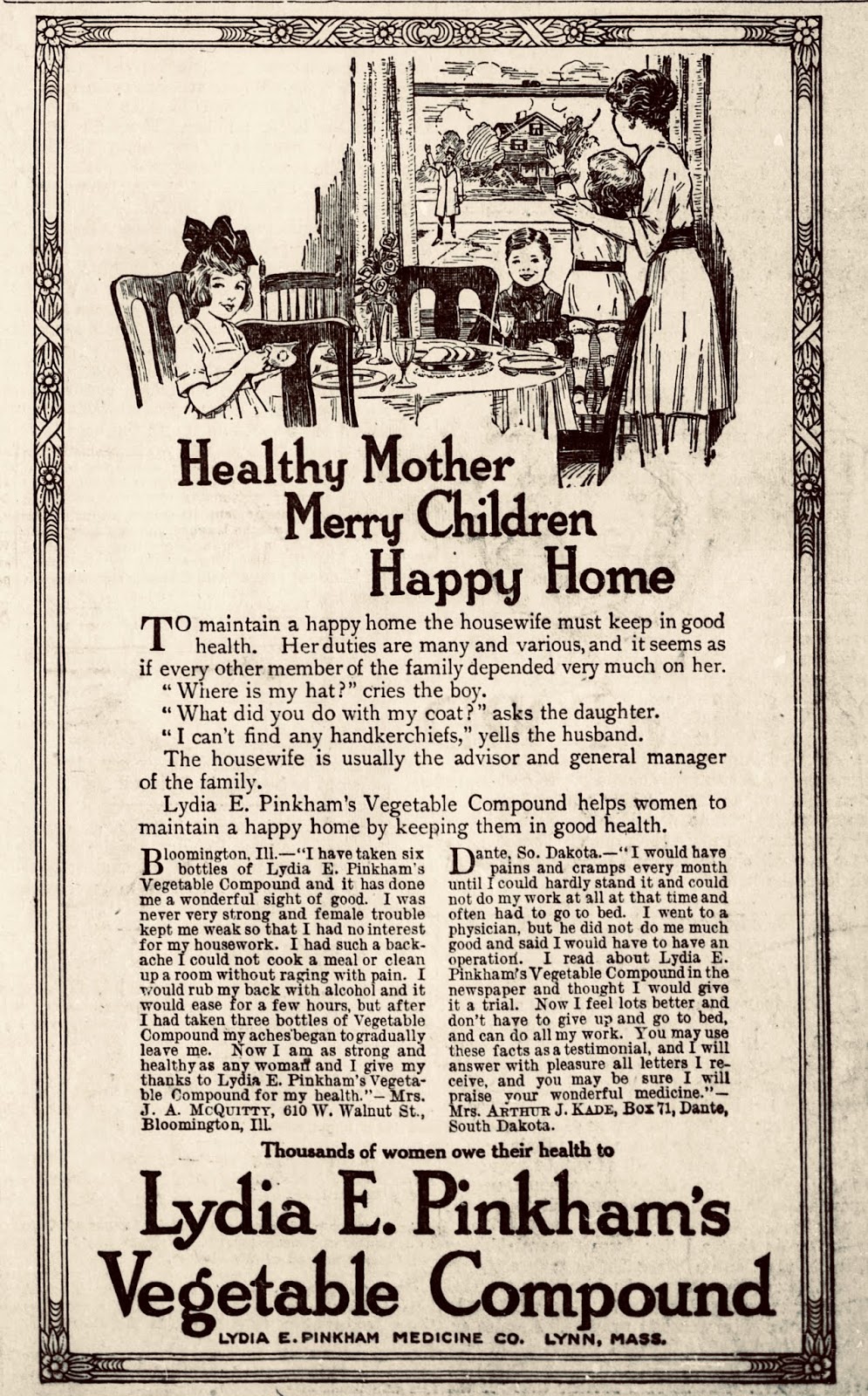
I love to see what life was like for women during Georgia Belle Graber’s days as a mother of young children. I wonder if she used Lydia’s E. Pinkham’s Vegetable Compound. The adverts for the elixir were found in all of the local and larger newspapers.


1921 Humor in the News

What was found funny in the news pages of the 1920’s... From May, 1921


Wilson College girls got out their examination books today and answered the now famous Edison questions. Here is the result of their labor over some of the questions:

Q. What star is it that has recently been measured and found to be of enormous size?

A. Fatty Arbuckle.

Q. Who was Cleopatra?

A. Anthony's sweetie.

Q. What is coke?

A. Seven cents, including; war tax.

Q. Where do we get peanuts from?

A. The circus.

Q. From where do we get our dates?

A. The University of Pennsylvania.

Q. To what is the change of seasons due?

A. Good teamwork on the part of the milliners and dressmakers.

Q. What state is the largest?

A. Matrimony.

Thursday, March 21, 2019

Boyabus Kissabus


Boyabus Kissabus a sweet girlorrum

Girlabus cryabus— “Wants some morum!”
Boyabus Kissabus — Walked old mamorum;
Boyabus kickedbus out the back doorum;
Girlabus cryabus, “Kisses no morum!”

By the author,
Ruth Martin


I found this charming verse when researching the women of the Graber Olive House family for a 4 month long exhibit at the Ontario Museum of History and Art in 2017.  

Ruth Martin was not a Graber, but her daughter, Betty, became one when she married Bob Graber in 1936. The paper was signed “By the author, Ruth Martin.” 

This style of speaking was called “hog Latin” and was all the rage with schoolgirls in the late-1800’s, and made comebacks several times in the early 1900’s.

Attend one of our popular “Talk with Tea” events and learn more about young women in the Victorian and Edwardian eras.

Thursday, October 4, 2018

About “Traditions and Tea”

All about “Traditions and Tea” at Georgia Belle et Cie”
Some of the many items we talk about at the Traditions and Tea events – Baby bib clips and napkin clips. We have them from the late 1800’s to the mid 1900’s 

We are located at the historic Graber Olive House in Ontario California. My husband’s grandfather, C. C. Graber, started the company in 1894. Our 1920's tea room setting is named after C.C.’s wife, Georgia Belle Graber. 

The 1920's were such a great time of change for the women in the U.S. and our talks and classes focus on man
y of those changes for women, the etiquette, dress and lifestyle of the era, and those preceding that time period.

Each talk or class is accompanied by refreshments in the form of an afternoon tea – scones, assorted finger sandwiches, dainty desserts and, of course, freshly brewed pots of tea! 

The price is $32.00 per person, and we serve unlimited scones, tea sandwiches and desserts, along with a variety of teas at each table.

Our talk on “Dining with Royalty; From Picnics to the Palaces” are fun and informative. One item people enjoy viewing is the original table seating chart for the dinner given in honor of the Duke of Gloucester’s visit to Australia in 1934. We don’t simply cover the British royal family, but dining with royals the world over, throughout history.

Each talk or class is approximately 2 hours. Our most popular talks are listed below—


  1. Designed for Dining – The What, ‘Ware and When of the Table
  2. Victorian Era Etiquette and Her Queen 
  3. Tea History and Tea Etiquette
  4. Reading the Tea Leaves and Other 19th Century Pastimes
  5. Dining with Royalty; From Picnics to the Palaces
  6. Victorian and Edwardian Era Fads and Fancies
  7. Dining Etiquette; the “Do’s and Don’ts” for the Table
  8. Shaped to Please; Pots, Their Purposes, the Cups and Pleasures
  9. Jane Austen's England and the Silver Fork Novel 
  10. Learning Tea Manners with “Little Betty” (for ages 6 and up, accompanied by an adult, these include a book)

To find out about upcoming Talks and Tea, or to book a private Talk and Tea for your group, club or special event, call me at 800.891.RSVP

 Outside the U.S.? Call 909.923.5650
We hope to see you soon at one of our many events! – Maura J. Graber 


Friday, September 28, 2018

Tea and Visiting Card Etiquette

Calling or “visiting cards” were very important in the early 1900’s. Especially if one was new to an area and getting acquainted. Even more so, if advertisements by card-makers were true and hostesses set upon the visiting cards the minute guests left, to see if the cards were proper or not! 

Georgia Belle Graber’s cards were very plain. She ordered them in 1907 when she married C.C. Graber and moved to Ontario to live and start her family.
According to Country Living magazine, austere calling cards were what the "true upper-crusters” (think Downton Abbey) used. They engraved their cards with nothing more than a name and avoided any sign of frivolity or fussiness, like images of birds or flowers. From what my late mother in-law, Betty Graber said, Georgia Belle would have probably been shocked to find that she was considered an “upper- cruster” due the simplicity of her calling card.
Newspapers and women’s magazines carried advertisements, like the one from 1907 pictured above, that played on the sensibilities of etiquette-minded women who wanted to do the socially correct thing. No woman of 1907 wanted to be seen as “entirely out of harmony with the demands of etiquette”!   


Posted by Site Editor, Maura J. Graber 

Thursday, September 13, 2018

Georgia Belle’s Calling Card Etiquette

One of my favorite items to show and discuss at our talks and teas, is a box of Georgia Belle Graber’s calling cards. Calling cards were the forerunners of today’s business cards. As she became “Mrs. Clifford Clement Graber” in 1907, and I was marrying his grandson and namesake in 1990, the box of cards, along with the copperplate for engraving, was an engagement gift to me from my late-mother in law, Betty Graber. Stop in and ask about them!
Pictured above and below– Georgia Belle Graber’s Edwardian era calling cards from 1907, sitting in an antique Pairpoint silver, calling card tray, atop two business cards for “Georgia Belle et Cie.” The tray features a tenacious dog who does not wish to give up the newspaper he has snagged and holds in his teeth. The newspaper is dated May 4, 1891 – 
On a reception day or at a tea you should leave your cards in the card tray in the hall on your departure. No call is necessary in acknowledgment of an afternoon tea. A card left or sent to a tea discharges the obligation.“ ~ from the Los Angeles Herald, 1891

“The wise woman carries cards with her wherever she goes, for there are many uses for them. Nowadays, she carries shopping cards also, and saves time and trouble when she makes purchases. A neatly engraved card is always in good taste, even when not strictly up to style, but a careful woman is modish in that, as in every other detail of her toilette.” 

Agony Aunt, Betty Bradeen’s, 1909 Etiquette Advice for Calling Card Use in the syndicated column, “Betty Bradeen’s Daily Chat”

“Sometimes I open letters to find that the desired information would be too late. That happens when social functions are looming up in the near future, and somebody has met a puzzling situation. Generally, such letters ask for information on the subject of visiting cards or notes of acceptance or regret. There are only a few rules governing the etiquette on such occasions, but they are important. Every woman should know them, even though she has no occasion for such knowledge. We learn a good deal which is never put to account, you know. 

“When a woman calls upon a new neighbor, she carries a card for each woman in the family and her husband’s cards as well, with one for the masculine head of the house. That is only for the first call; which is returned in like manner, and then the acquaintance is purely a matter of individual choice. The demands of etiquette have been met. Cards are convenient things even after terms of intimacy have been established, for they serve as reminders of visits whigh might be forgotten or might never be known. The wise woman carries cards with her wherever she goes, for there are many uses for them. Nowadays, she carries shopping cards also, and saves time and trouble when she makes purchases. A neatly engraved card is always in good taste, even when not strictly up to style, but a careful woman is modish in that, as in every other detail of her toilette.

“Letters of acceptance or regret are imperative, and shortcomings in this line are never overlooked. The sender of an invitation has a right to expect the courtesy of a reply of some sort — and the nature of the reply has much bearing upon the success of the function. In wedding invitations, the answers are sent to those who issue them, no matter whether there is an acquaintanceship or not. For instance, the parents of a bride send many such to friends of the bridegroom, persons they have never seen, but answers are due them just
the same.” –Betty Bradeen, 1909


Etiquette Enthusiast, Maura J. Graber, is the Site Editor for the Etiquipedia© Etiquette Encyclopedia
Sunday, August 19, 2018

Vintage Glove Etiquette

Glove fashion article from 1933 – We love history, etiquette and fashion! We also love talking about what we collect. Next time you are in the neighborhood, stop by the Graber Olive House for one of our Talks and Tea, or call 909-923-5650 in advance, to see what topics are on our upcoming schedule and see our collections of vintage fashion accessories and antique flatware in our La Casita shop. 


Glove Etiquette 

Don’t eat, drink, or smoke with gloves on.
Don’t play cards with gloves on.
Don’t apply makeup with gloves on.
Don’t wear jewelry over gloves, with the exception of bracelets.
Don’t make a habit of carrying your gloves.


For more glove etiquette, read one of Maura Graber’s post here on her Etiquette Sleuth Blog